Lower Level
Build confidence with arithmetic, fractions, measurement, data, geometry, and early algebraic reasoning.
ISEE Math Tutoring
Level-appropriate ISEE mathematics and quantitative reasoning preparation built from diagnostics, clear instruction, and purposeful practice.
A clearer starting point
Students need age-appropriate mathematical foundations, but they also need to recognize the kind of problem in front of them, choose an efficient route, and manage unfamiliar wording without becoming stuck.
Preparation begins with the student’s level and current evidence. Lessons address the concepts that are actually weak while teaching a calm process for reading, setting up, estimating, solving, and checking.
Build confidence with arithmetic, fractions, measurement, data, geometry, and early algebraic reasoning.
Strengthen number sense, proportional reasoning, algebra, geometry, statistics, and multi-step problem solving.
Review more advanced algebra, geometry, functions, data analysis, and efficient quantitative reasoning.
What we work on
Each set should answer a question about the student—not simply add more volume.
Repair the content gaps that cause repeated misses across multiple question types.
Notice the mathematical structure beneath unfamiliar language.
Know when to continue, estimate, mark a question, or return later.
Record why an answer was missed and what cue should trigger a better choice next time.
The teaching process
Use level-appropriate work to identify content, reasoning, and pacing priorities.
Explain the mathematics clearly and connect it to the way ISEE questions present the idea.
Use focused and timed practice to make the improved approach reliable.
Selected evidence
The records below are already part of the Tzeng Tutoring results collection. Identifying details have been redacted.
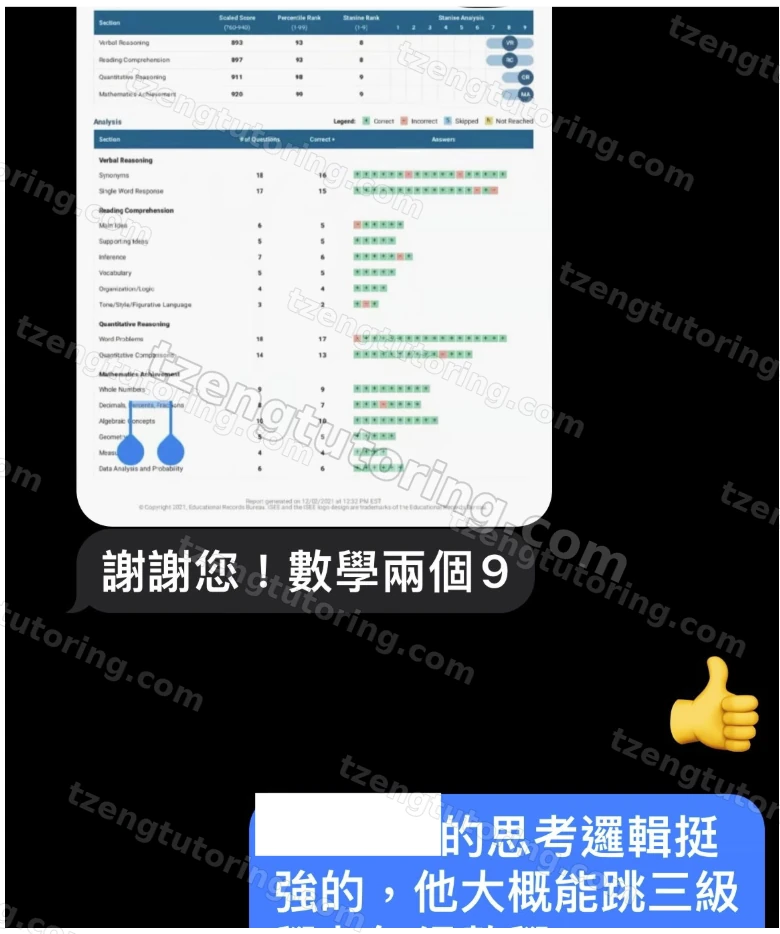
A redacted score report and family message shared two mathematics stanine scores of 9.
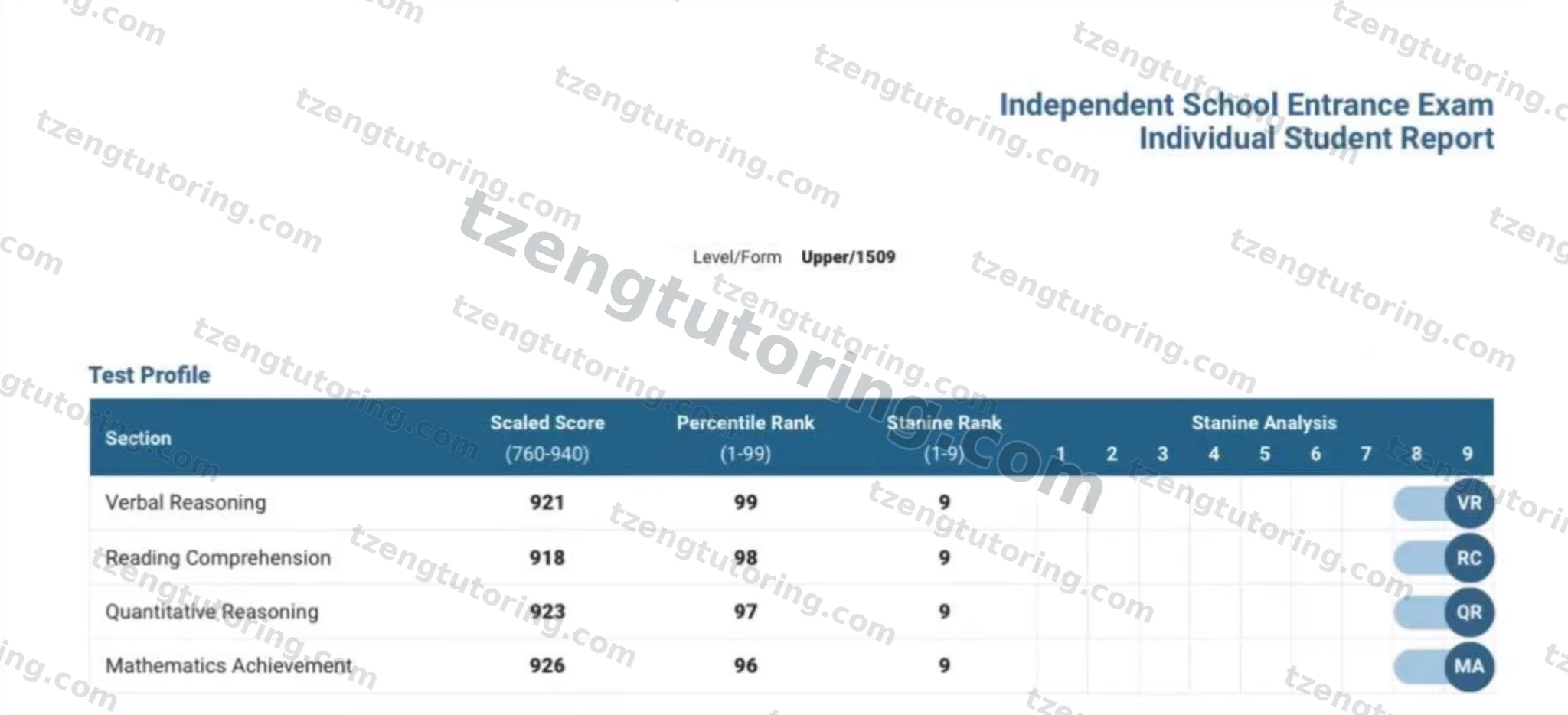
A redacted Upper Level score report showed percentile ranks from 96 to 99.
Free consultation
Share the planned test level, approximate timeline, and any available diagnostic or practice results. The first conversation can identify the most useful starting point.