Diagnostic review
Use completed work or practice results to identify the concepts and habits that are costing points.
SAT Math Tutoring
One-to-one SAT Math preparation built from diagnostic evidence, recurring error patterns, and timed practice—not a generic stack of worksheets.
A clearer starting point
SAT Math improvement is rarely about doing more random questions. The first step is to separate content gaps from reading mistakes, setup errors, calculator choices, and pacing decisions.
Lessons connect those patterns to the mathematics underneath them. Students practice how to choose an efficient representation, carry out the work accurately, and check whether the result makes sense before moving on.
Use completed work or practice results to identify the concepts and habits that are costing points.
Rebuild the specific algebra, geometry, data, or problem-solving skills behind repeated misses.
Practice selecting methods and checking work under realistic time pressure.
What we work on
The goal is a method the student can use independently on test day.
Translate the question into quantities, relationships, and constraints before calculating.
Decide when algebra, a table, a graph, estimation, or the calculator is the clearest route.
Use units, sign, scale, and the wording of the question to catch avoidable errors.
Turn every correction into a short note about what happened and what to do next time.
The teaching process
Review the student’s current work and isolate the highest-value areas for attention.
Make the underlying mathematics clear with more than one representation when useful.
Use focused practice, review, and timed sets to make the improved process repeatable.
Selected evidence
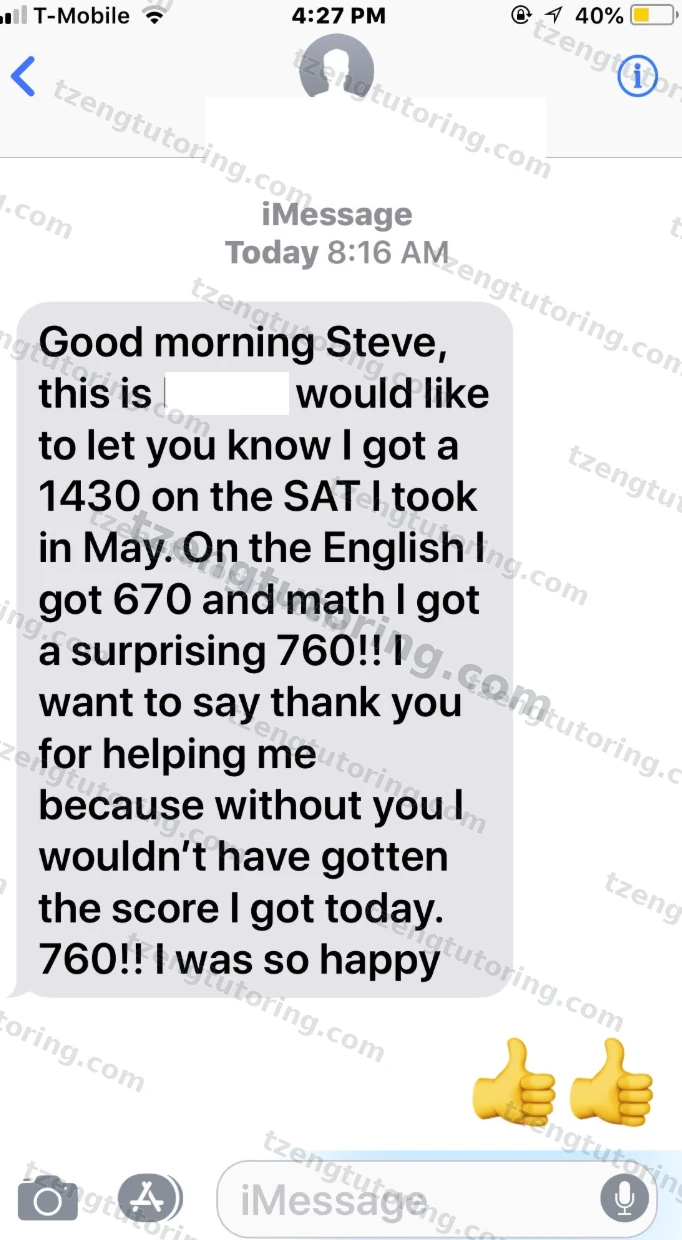
The records below are already part of the Tzeng Tutoring results collection. Identifying details have been redacted.
A redacted student message shared a 1430 SAT score with a 760 Math score.

A redacted parent message shared a 740 Math score after an improvement of more than 100 points.
Free consultation
Share the student’s current score range, recent practice, and target timeline. The first conversation is a chance to discuss fit and a practical next step.